🎵 Dr. Beat – Gloria Estefan & Miami Sound Machine
(https://youtu.be/nAEil3_D03k?si=wBUF_iosxu5Sqh8a)
Here’s the official medical summary about the cancer and pathology results. Underneath this I’ve put normal Sam speak translated care of my mate AI. I won’t say any more, other than thank goodness I went to get it checked when I did and that they have moved quickly. It’s a long summary when translated but I found it very interesting
(skip this one if you’re not bothered but please never ever skip getting your boobs or odd lumps and bumps checked out if you ever have concerns).
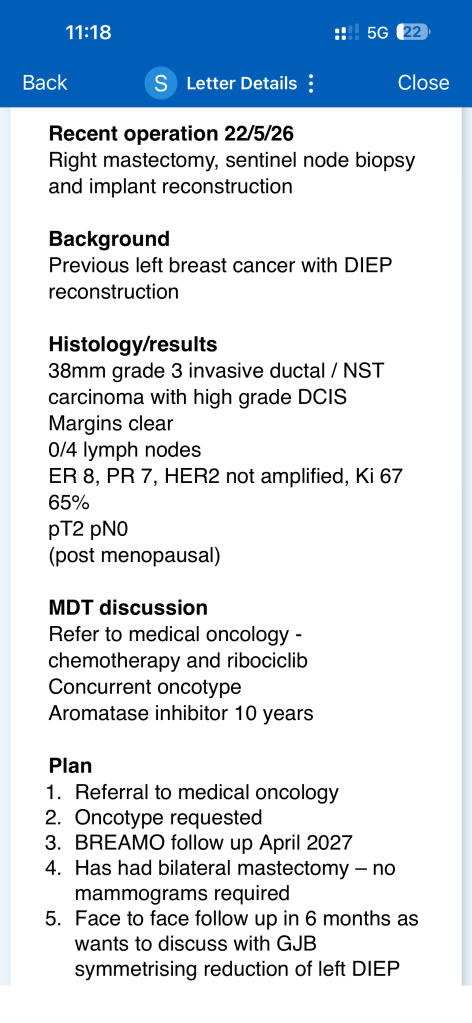
Right Mrs Vickerman, let’s translate the consultant-speak into normal human language… 😘
What they actually found
38mm Grade 3 invasive ductal / NST carcinoma with high-grade DCIS
Sam translation:
The tumour they removed was 3.8cm across (about the size of a large grape or small plum).
Invasive ductal carcinoma (IDC/NST) is the most common type of breast cancer. It means the cancer had started to move outside the milk ducts into surrounding breast tissue.
Grade 3 means the cancer cells looked quite different from normal cells and were growing relatively quickly.
High-grade DCIS means there was also some cancer contained within the milk ducts alongside the invasive cancer.
Bottom line: It wasn’t tiny, and it was a faster-growing cancer, but they got it out.
Margins clear
The surgeon removed the cancer and when the pathologist examined the tissue, there was a rim of healthy tissue all the way around it.
In other words:
“We’ve got the bugger.”
No cancer seen at the edges.
0/4 lymph nodes
They tested four lymph nodes.
All four were clear.
No evidence the cancer had spread into the lymphatic system.
ER 8, PR 7
The cancer is strongly hormone-sensitive.
ER = Oestrogen Receptor
PR = Progesterone Receptor
The scores run from 0-8. You scored:
- ER = 8/8
- PR = 7/8
Which basically means:
This cancer absolutely loves hormones.
The good news is that hormone-sensitive cancers have effective treatments available to help stop recurrence.
HER2 not amplified
HER2 is another growth signal that some breast cancers use. Yours is HER2 negative. Which means:
- No Herceptin needed this time
- Not being driven by HER2
Ki67 65%
This measures how many cancer cells were actively dividing.
65% is fairly high.
Which basically confirms what Grade 3 already suggested:
This was an active, fast-growing little sod.
It helps explain why they’re discussing chemotherapy.
pT2 pN0
This is cancer staging shorthand.
T2 = tumour between 2cm and 5cm
(Your 3.8cm tumour fits here.)
N0 = no lymph node involvement
(Your 0/4 nodes.)
MDT Discussion
This is the bit where all the clever people sat around a table discussing you.
Refer to medical oncology
Time to meet the chemotherapy and drug experts. They’ll look at all your results and recommend treatment.
Chemotherapy and Ribociclib
This doesn’t necessarily mean you’ve definitely got chemotherapy.
It means the MDT think chemotherapy should be discussed seriously because of:
- Grade 3
- 38mm tumour
- Ki67 65%
Concurrent Oncotype
They’re sending off the Oncotype DX test.
This test looks at the genetics of the tumour and estimates:
- Risk of recurrence
- Whether chemotherapy is likely to help
For hormone-positive, HER2-negative cancers like yours, it can sometimes show that chemotherapy adds very little benefit. So:
The Oncotype result may influence the final chemotherapy decision.
You haven’t had that answer yet.
Ribociclib
This is one of the newer targeted cancer drugs.
Because:
- Grade 3
- Tumour over 2cm
You fit the type of patient where oncologists may recommend it alongside hormone therapy.
It’s taken as tablets rather than chemotherapy drips.
Aromatase inhibitor 10 years
This is almost certainly happening.
You’ll be offered a hormone-blocking tablet for 10 years.
Examples include:
- Letrozole
- Anastrozole
- Exemestane
These reduce the body’s oestrogen levels.
Since your cancer loved oestrogen, this helps reduce recurrence risk.
The Plan
Referral to medical oncology
Meet the oncology team.
Oncotype requested
Waiting for the extra test result that may help decide whether chemo is worthwhile.
BREAMO follow-up April 2027
Routine breast team follow-up next year.
Has had bilateral mastectomy – no mammograms required
You’ve now had both breasts removed so there isn’t breast tissue left to routinely screen with mammograms.
Future follow-up relies more on:
- Clinical examination
- Symptoms
- Specialist review
Face-to-face follow-up in 6 months to discuss symmetrising reduction of left DIEP
You’ve told them your older reconstructed breast is now bigger than the new implant reconstruction.
So they’ll see you again to discuss making things match better. Basically:
“Can we get these sisters looking more like sisters?” 👯♀️ 🤣


 Living with Molly: Here We Go Again!
Leave a comment